Modular Enclosure
A sliding shelf system that carries the electronics, lights, and experiment module — built in two distinct configurations for drop testing and long-term plant growth.
Two Configurations, One Enclosure
Drop Test Setup
- No TDS or pH sensor, in exchange for a larger pump
- Larger, high-capacity pump installed
- Channel capacity: ≈ 10.12 mL max
- Fills channels as much as possible within the 2.2 s drop window
- Optimized for short-duration data collection
Long-Term Growing Setup
- TDS (Total Dissolved Solids) sensor included
- pH sensor included
- Larger reservoir for extended growing sessions
- Smaller, precise pump (320mA savings over the drop-test pump)
- Fine-grain water delivery tuning
- AI actively monitors and controls watering
Enclosure Design
Sliding Shelf System
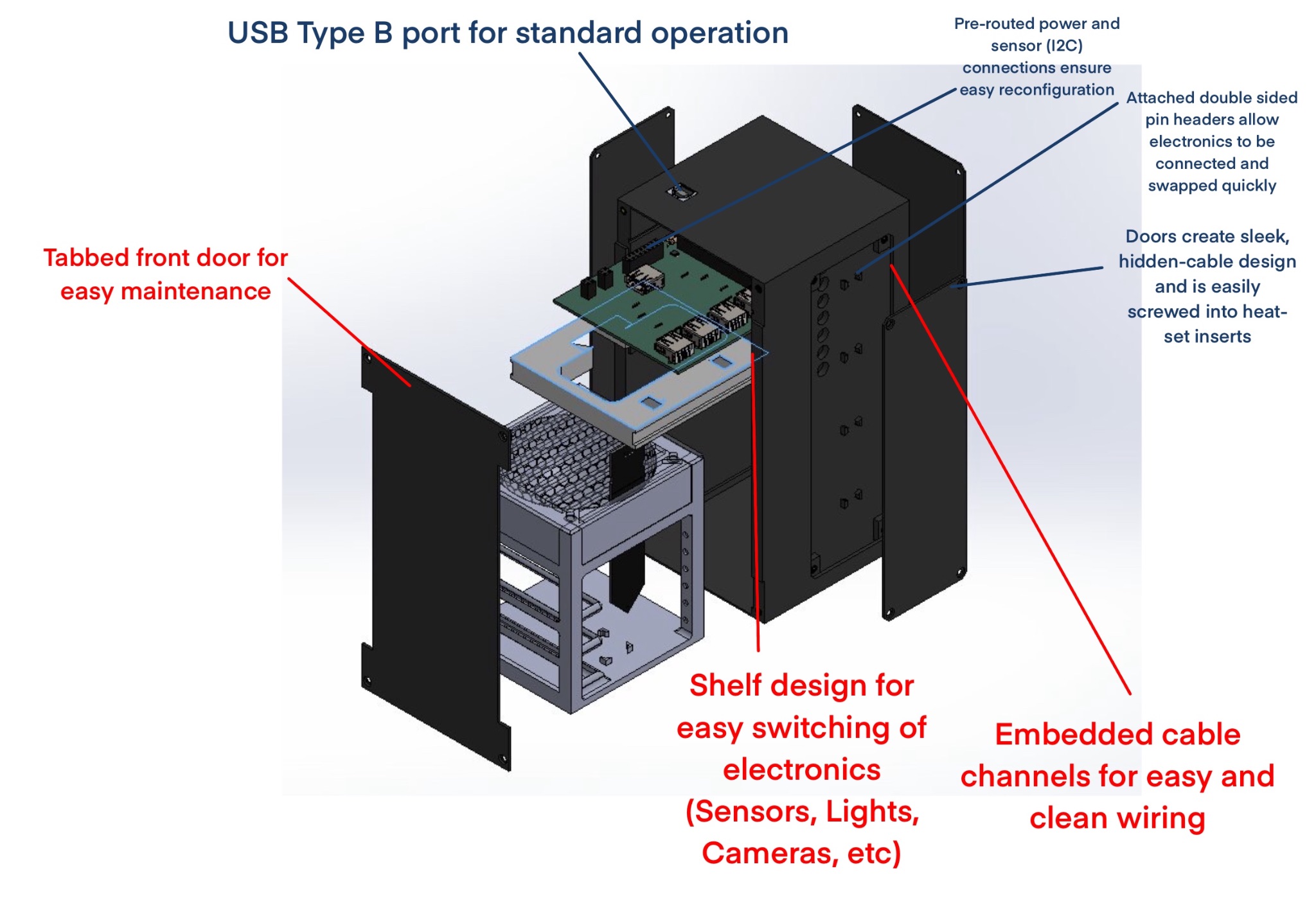
Electronics, lights, and the experiment module all slide in on shelves, so parts can be swapped out for maintenance.
Hollow Side Walls
Cable management routes through hollow walls, keeping electronics clear of water exposure.
Front & Side Doors
Panel doors open onto the internal components and the experiment module for quick access.
Modular Slots
The experiment module slot accepts the TDC (capillary plate), substrate tray, or future experiment types.
The NASA HUNCH Design Space
Every dimension of the enclosure answers to a NASA HUNCH constraint. The envelope is a 2U nanolab (20 × 10 × 10 cm) with no more than 50 mL of water on board. Water has to move freely in microgravity — ideally passively, though pumps are allowed — and every sensor, camera, light, and electronic part has to live inside the sealed system, with condensation kept away from the electronics.
One Enclosure, Two Missions
The sliding shelf system lets a single enclosure serve both missions. The drop-test build runs a high-capacity 150 mL/min pump to flood the channels inside the short drop window; the long-term build swaps in a precision 1 mL/min pump alongside the TDS and pH sensors for sustained, fine-grain watering under AI control.
Iterating the Hardware
Door Screws
M3 × 6 mm screws on the front door; M2.5 screws on the side and back doors.
Walls
4 mm → 2 mm walls, freeing internal volume without losing rigidity.
Wire Holes
5 mm → 8 mm wire holes, so cable routing no longer binds.
Substrate Modules
M4×6 mm screws with M4 thread inserts — a stronger, repeatable mount for the substrate modules.
Wiring went solderless and swappable: pin headers plus side and back clips mean boards can be swapped without soldering, so the enclosure is serviceable in minutes instead of rebuilt.
Manufacturing Split
The enclosure body prints in FDM — economical, tough, and good enough for every non-critical surface.
Only the critical hex dome is SLA-printed in resin — a polar material chosen specifically to drive capillary adhesion in the channels.