Geometry
The unique geometry of our water delivery system efficiently utilizes capillary action and its amplified uses in microgravity.
Inspired by the Thorny Devil Lizard
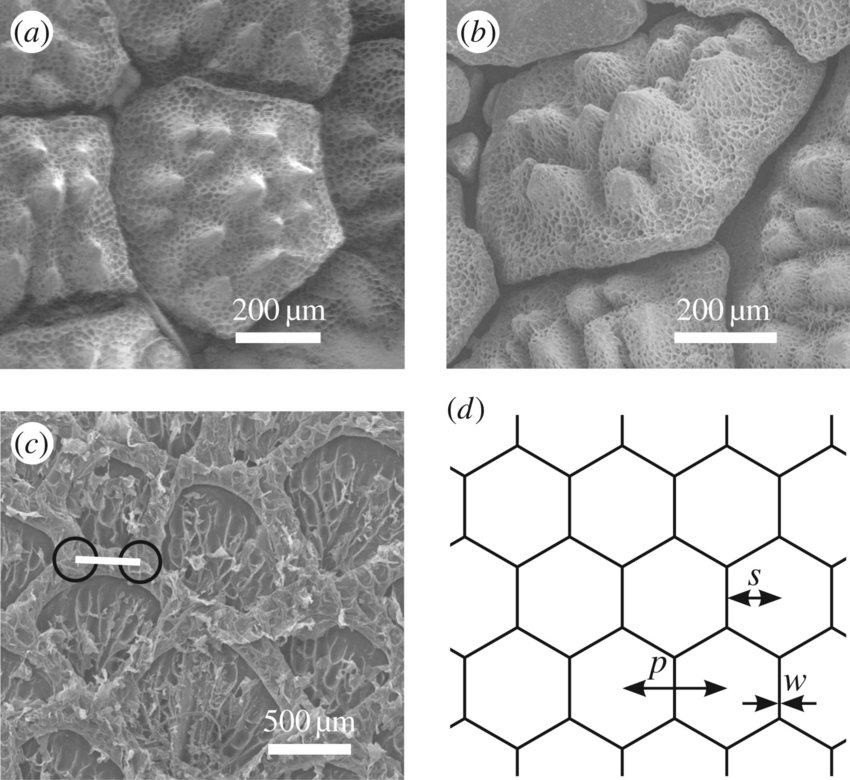
The HexaFlow water delivery system draws from the Moloch horridus — the thorny devil lizard — which uses capillary action to transport water through microscopic grooved patterns on its skin. The honeycomb-like geometry of its scales passively moves water from any surface contact point directly to its mouth, with no muscular effort.
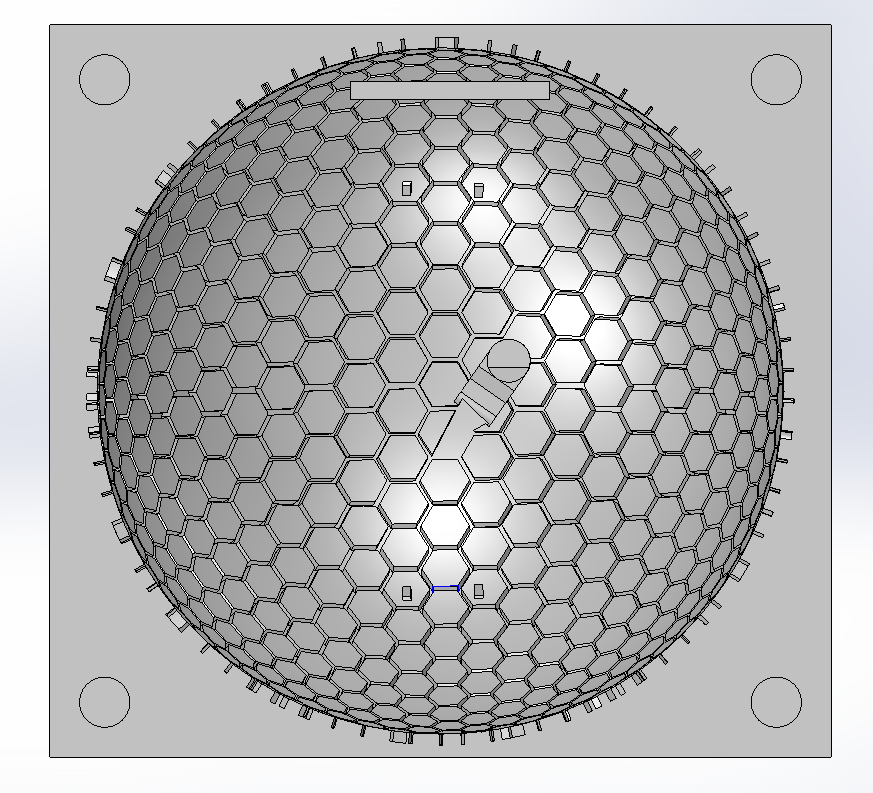
HexaFlow replicates this hexagonal channel geometry at a functional scale using SLA 3D printing with resin material. Resin's polar properties create stronger adhesion bonds with water than water molecules share with each other — this is what drives the capillary flow. At the proper scale, the system can retain water even when fully inverted.
The hexagons are spaced 0.020 in (0.51 mm) apart — that gap is the capillary channel water travels through.
Why the channels hold water
Resin is a polar material, so it bonds to water more strongly than water bonds to itself. That stronger adhesion is what drives efficient capillary transport through the hex network — and it lets the system hold water even when fully inverted. Only the critical hex dome is SLA-printed in resin; the body is FDM.
Total channel capacity is 10.12 mL (precisely 10.1155 mL) when fully saturated — roughly 10 minutes of constant flow at the 1 mL/min long-term pump rate to saturate.

Technical Specifications
Source: Skin morphology study of Moloch horridus — ResearchGate. Capillary channel geometry and polar adhesion principles adapted for SLA resin fabrication.